From our blog
Laser, oxy-fuel or plasma? How to choose the right cutting method for your job
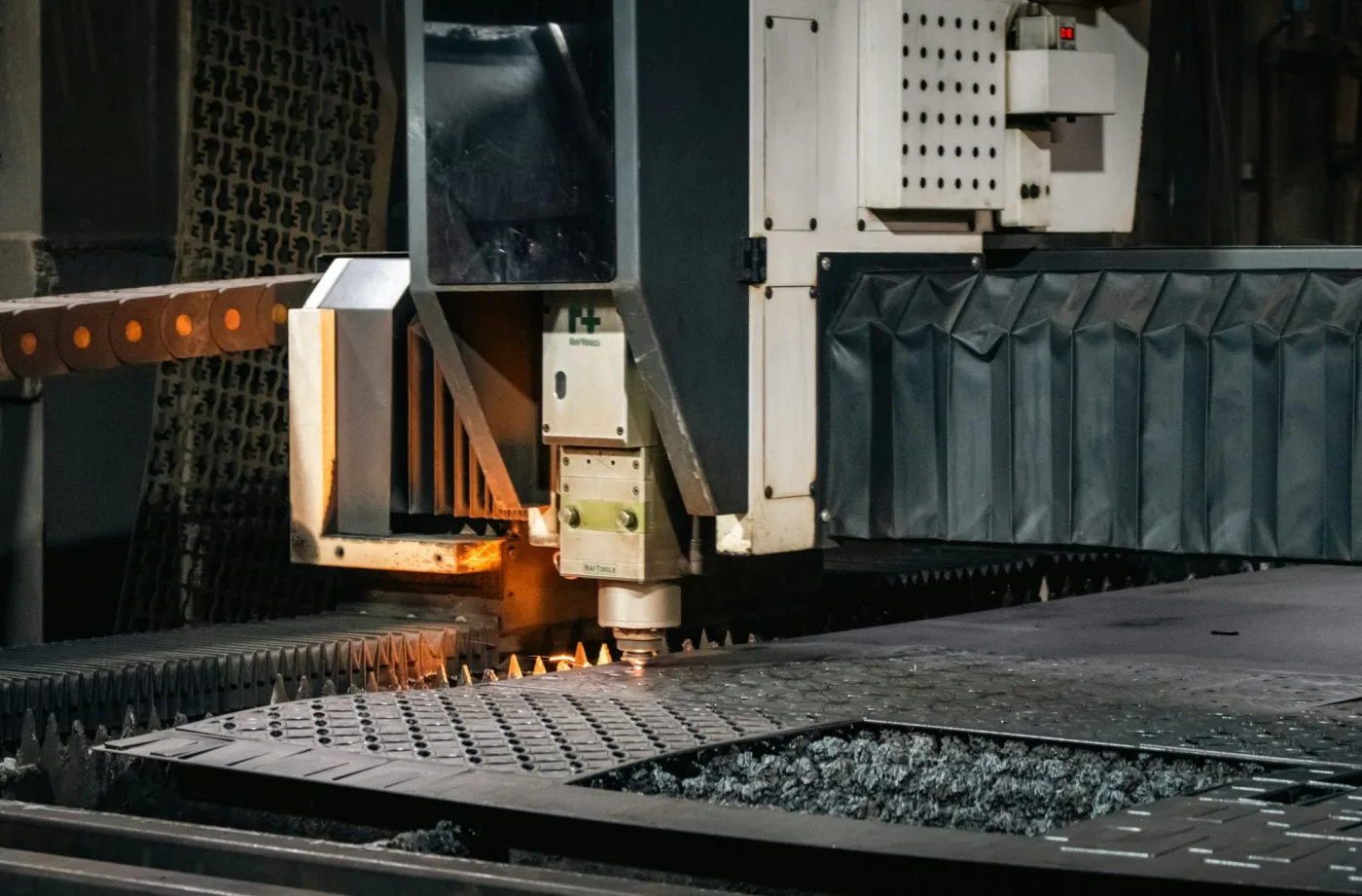
The question we hear most with quote requests is: “Should this part be laser cut or oxy-fuel cut?” The answer depends on four things: thickness, material, required tolerance and quantity. Here is how we decide every day when we review drawings in our Jeddah workshop.
Fiber laser cutting: precision first
A fiber laser concentrates a lot of energy into a tiny spot, melting the metal while an assist gas (oxygen or nitrogen) blows it out of the cut. You get a clean edge, a kerf of typically 0.2–0.4 mm and a very narrow heat-affected zone.
- Sweet spot: 0.5–25 mm carbon steel, and our 12 kW laser reaches 40 mm. Stainless up to 30 mm, aluminium up to 25 mm.
- Accuracy: around ±0.1 mm, with small holes and sharp corners and no secondary finishing.
- Best for: custom parts, base plates, brackets, architectural panels and anything that must fit on site without rework.
Oxy-fuel cutting: king of thick plate
A fuel-gas flame heats the steel to ignition temperature, then a jet of pure oxygen oxidises it and blows the oxide away. Because the process is essentially chemical, cost rises only slowly with thickness.
- Thickness: 6 mm up to 150 mm and beyond on our CNC table, with several torches running at once.
- Materials: carbon and low-alloy steel only — it does not cut stainless or aluminium.
- Best for: flanges from thick plate, heavy base plates, crane and machine parts, and bevel cuts for weld preparation.
Plasma: the fast middle ground
Plasma uses an electric arc and ionised gas above 20,000 °C, so it cuts any conductive metal. It is faster than oxy-fuel on medium plate (6–40 mm) and cheaper than laser on thick plate, but the edge has a slight bevel and accuracy is lower than laser.
Quick comparison
| Criterion | Fiber laser | Plasma | Oxy-fuel |
|---|---|---|---|
| Best thickness range (carbon steel) | 0.5–25 mm (up to 40) | 6–40 mm | 20–150 mm |
| Stainless & aluminium | Yes | Yes | No |
| Typical accuracy | ±0.1 mm | ±0.5 mm | ±1 mm |
| Heat-affected zone | Very narrow | Medium | Wide |
| Bevel cutting | Limited | Yes (3D head) | Yes |
The rule of thumb we use
- Under 20 mm with tight tolerances or small holes? Laser.
- 20–40 mm in volume? Plasma is usually the most economical.
- Over 40 mm carbon steel, or you need a weld bevel? Oxy-fuel.
Not sure? Send us your DXF or DWG with material, thickness and quantity. Our engineers will recommend the most economical method that holds your tolerance, and nest the parts on the plate to cut waste.
Have a drawing?
Send us your drawings and quantities and get a clear quote fast.